
More Than a Century of Mosquito Control: What World Mosquito Day Means for Your Neighborhood
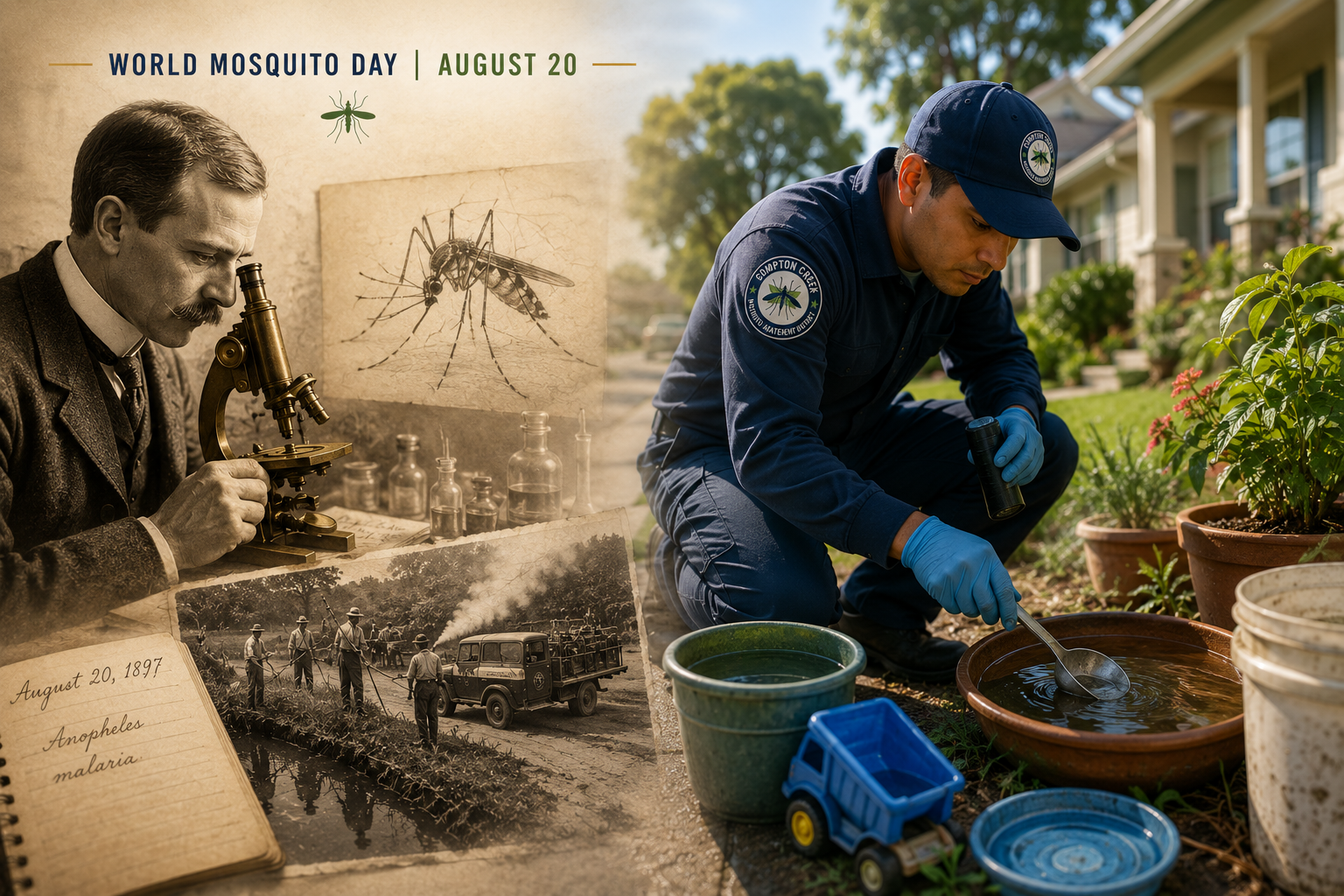
World Mosquito Day is observed each year on August 20 to mark Sir Ronald Ross's 1897 discovery linking mosquitoes to malaria transmission — a breakthrough that launched more than a century of public health science. Compton Creek Mosquito Abatement District traces the evolution of mosquito control from early 20th century drainage programs through integrated mosquito management, explaining what changed, why it matters, and what that history looks like today across our 12.5 square mile service area in Compton, Lynwood, Paramount, and Rancho Dominguez — including free mosquitofish, property inspections, and West Nile Virus surveillance available to every resident.
Every August 20, World Mosquito Day marks one of the most consequential discoveries in the history of public health. Most residents have never heard of it. But the science behind that 1897 discovery — and more than a century of work that followed — is exactly what allows Compton Creek Mosquito Abatement District to protect roughly 100,000 residents across Compton, Lynwood, Paramount, and Rancho Dominguez every summer. The answer to why mosquitoes are active in your neighborhood is closer than most people expect — and it connects to more than a century of public health work.
August 20, 1897: The Discovery That Changed Public Health
On August 20, 1897, British physician Sir Ronald Ross working in India made a discovery that would reshape medicine and public health for the next century: he confirmed that the Anopheles mosquito was the carrier of malaria parasites. The finding established for the first time that a specific mosquito species was responsible for transmitting a disease that was killing millions of people annually across the globe.
Ross received the Nobel Prize in Medicine in 1902 for this work. Three years earlier, in 1900, U.S. Army physician Walter Reed confirmed a parallel finding — that yellow fever, then devastating communities across the Americas, was transmitted through mosquito bites rather than through contact or contaminated water as previously believed. These two discoveries, separated by only three years, fundamentally changed what public health agencies understood about disease transmission and what they could actually do about it.
More Than a Century of Science: How Mosquito Control Evolved
The years that followed Ross's discovery produced a steady evolution in how mosquito control agencies approach their work — from large-scale environmental manipulation to highly targeted, science-based integrated management. Understanding that evolution helps explain why modern mosquito control looks the way it does, and why what happens in your backyard matters as much as what happens in public waterways.
Early mosquito control focused on large-scale drainage of swamps, marshes, and standing water bodies. The Panama Canal construction — notorious for yellow fever and malaria deaths among workers — was completed in part because of aggressive mosquito control programs that drained standing water throughout the construction zone.
The mid-20th century saw widespread use of DDT — a broad-spectrum insecticide that dramatically reduced mosquito populations across many parts of the United States. Malaria was eliminated from the continental U.S. by the early 1950s, in part due to these efforts. However, growing evidence of DDT's environmental persistence and its impact on non-target species led to its eventual restriction and a fundamental rethinking of how mosquito control should be practiced.
The post-DDT era produced Integrated Mosquito Management (IMM) — a science-based framework that targets mosquitoes at the most vulnerable points in their life cycle using the most environmentally responsible tools available. Biological controls, source reduction, targeted treatments, and public education replaced broad-spectrum application methods as the foundation of professional mosquito control.
Modern mosquito control is precise, data-driven, and community-integrated. Districts like Compton Creek Mosquito Abatement District use real-time surveillance data, targeted biological treatments, mosquitofish distribution, and resident education to manage mosquito populations at the neighborhood level — reaching the places public infrastructure cannot.
What Changed — and What That Means for Your Block
The single most important shift in more than a century of mosquito control science is the understanding of where mosquitoes actually breed. Early control efforts focused on draining large public water bodies. Modern field data consistently identifies private residential property — not public waterways — as a major source of local mosquito breeding.
The practical implication of this evolution is direct: what a resident does in their backyard is not supplementary to professional mosquito control. It is a necessary part of it. Public waterways and drainage infrastructure are managed by the district. Residential containers, garden beds, gutters, and ornamental water features are on private property — and can only be addressed by the people who live there.
What More Than a Century of Science Looks Like in Your Neighborhood Today
Compton Creek Mosquito Abatement District was established to be the local expression of that deep body of knowledge built over more than a century — bringing professional, science-based mosquito control to the specific conditions of southeast Los Angeles County. Our service area covers 12.5 square miles and approximately 100,000 residents across Compton, Lynwood, Paramount, and Rancho Dominguez.
In practical terms, modern mosquito control in our service area means regular inspections of drainage channels, waterways, and catch basins throughout the area. It means targeted biological treatments using EPA-registered methods at identified breeding sites. It means West Nile Virus surveillance coordinated with the California Department of Public Health. And it means mosquitofish — one of the most enduring tools in the history of biological mosquito control — available free to every resident with an ornamental pond or water feature.
Mosquitofish (Gambusia affinis) have been used in biological mosquito control since the early 1900s — one of the earliest biological control tools in recorded mosquito control history. After the mid-20th century restrictions on broad-spectrum insecticides, biological controls including mosquitofish were elevated within the Integrated Mosquito Management framework as a preferred first-line tool. These small freshwater fish consume mosquito larvae naturally, providing ongoing season-long control in ornamental ponds, water features, and horse troughs with no treatments required. Compton Creek Mosquito Abatement District provides mosquitofish free of charge to all residents within our service area — up to 500 fish per household per day.
Request Free Mosquitofish →Your Role in More Than a Century of Progress
World Mosquito Day is observed to increase awareness — not just about the history of mosquito control, but about the ongoing partnership between public health agencies and the communities they serve. In 1897, the discovery that mosquitoes transmitted malaria gave scientists a target. In 2026, the research is clear that residential source reduction — eliminating the standing water in backyards, gutters, and containers — is one of the most effective tools available.
That makes every resident in our service area a participant in a public health effort spanning more than a century. The actions are simple and well-established: dump standing water, check containers weekly, eliminate the bottle cap of water that a mosquito needs to start a breeding cycle. Add repellent during dawn and dusk hours. Report public breeding sites. Request mosquitofish if you have ornamental water. These are not just seasonal tips — they are the community layer of an integrated system refined over generations of public health science.
District Services Available to Every Resident
Compton Creek Mosquito Abatement District provides the following services at no cost to all residents within our 12.5 square mile service area.
Up to 500 per day for ornamental ponds and water features. One call. Natural, season-long larval control.
District personnel inspect your property for mosquito problems and advise on control at no cost. Request on contact.
Standing water in an alley, storm drain, or neglected public space? Report it. We investigate.
Hands-on mosquito prevention education for grades 4–6 at all 24 elementary schools in our service area.
Found a Dead Bird? Report It.
Dead crows, ravens, and jays are early indicators of West Nile Virus activity. Call the California Dead Bird Reporting Hotline.
Learn What CCMAD Does in Your Neighborhood
More than a century of public health science is at work in your community every week. Contact Compton Creek Mosquito Abatement District to request mosquitofish, report a breeding site, or schedule a free property inspection.
Contact CCMAD → Request Free Mosquitofish →Historical information sourced from the American Mosquito Control Association and the Centers for Disease Control and Prevention. West Nile Virus surveillance: cdph.ca.gov. Repellent guidance: epa.gov/insect-repellents.